Selected projects

Systems that make AI more useful in the real world.

My projects focus on the infrastructure around intelligent systems: context, evidence, tools, operating boundaries, and the workflows that connect an idea to production.

Knowledge infrastructure

The Vault

A persistent, source-grounded wiki that turns product and engineering evidence into focused context for people and AI agents.

  • Immutable evidence and regenerable synthesis
  • Repository, topic, and organization-level context
  • Automated ingest, compile, query, and health workflows
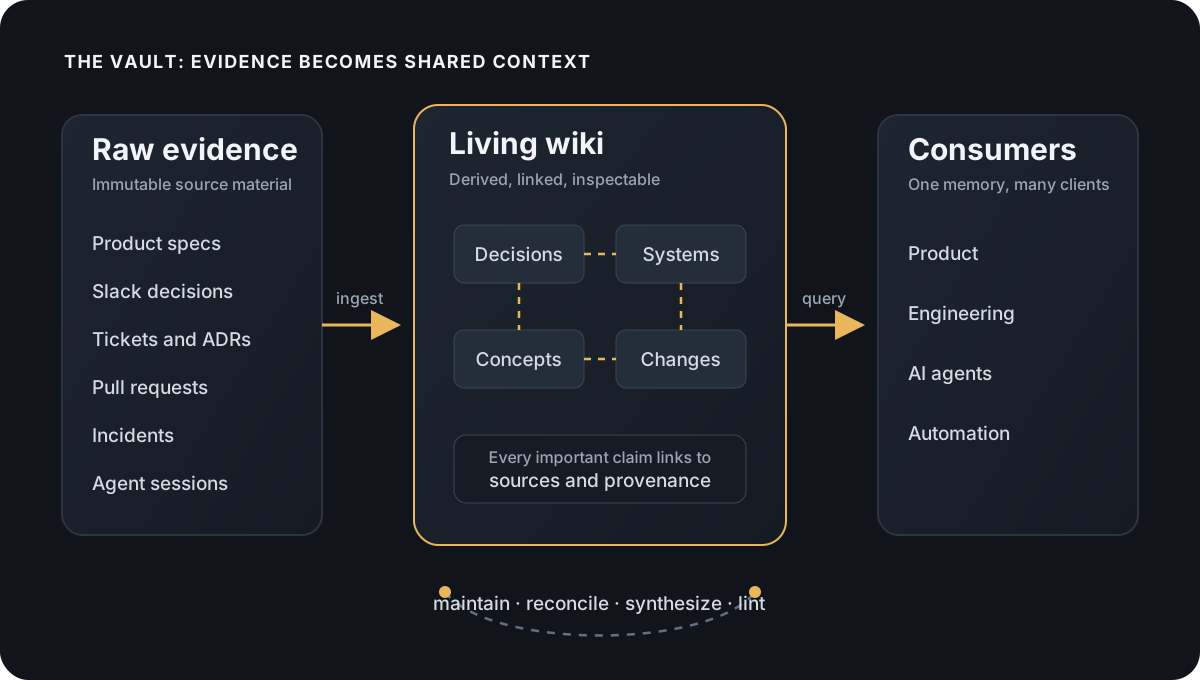
The Vault turns immutable evidence into a linked wiki used by people, AI agents, and automation.
Billy's AI Skills maps a large source field through a controller and focused agents into an evidence-backed result.
A controller inspects large context, delegates focused work, and converges the evidence into one answer.

Agent infrastructure

Billy's AI Skills

Cross-client Recursive Language Model workflows for Claude Code and OpenAI Codex, built to reason across repositories, documents, logs, transcripts, and other large source sets.

  • Bounded fanout, cost controls, and dry-run planning
  • Tested Claude and Codex marketplace implementations
  • A public product-launch corpus with a reproducible terminal demonstration

The project keeps raw context outside the main conversation, delegates focused questions over chunks, and returns a source-grounded synthesis. The example requires no private data or provider credentials.

Hugo combines RSS feeds and saved links, ranks and summarizes them with Claude, and delivers a focused team digest.
Automated curation turns a noisy reading queue into a focused technical digest for the team.

Applied AI product

Hugo

A self-hosted Slack reading assistant that scans AI and technology RSS feeds, uses Claude to rank and summarize articles, and posts a focused daily digest.

  • Configurable relevance scoring and bounded daily curation
  • On-demand URL summaries, thread summaries, and saved-link queues
  • Python, Slack Socket Mode, Claude, RSS, and Docker Compose

Hugo combines an always-on bot with scheduled curator and digest workers. The result is a small but complete AI product: ingestion, judgment, extraction, summarization, delivery, configuration, and operational alerts.

A Neverending Story Pointer room with story details, a timer, estimation choices, a participant, sharing controls, and history.
One room holds the story, estimates, participants, timer, reveal controls, and history.

Real-time collaboration

Neverending Story Pointer

A free, no-sign-up planning-poker room for teams that need to move from private estimates to a useful conversation without ceremony.

  • Shareable rooms with no account setup
  • Private voting with deliberate reveal and reset
  • Story context, participant state, a timer, and history in one place

The product keeps facilitation intentionally narrow: one room, one story, one reveal. Its Blazor WebAssembly client delivers an application-like workflow from a simple link.

How Unique Is a GUID showing a field of identifiers, a generated GUID, and an explanation of its digital fingerprint.
The opening interaction makes an astronomical identifier space tangible before introducing the calculators.

Interactive explanation

How Unique Is a GUID?

An interactive explanation that turns 122 bits of randomness and abstract collision probability into something people can see, calculate, and reason about.

  • Arbitrary-precision collision and birthday-paradox calculations
  • Personal witness models and human-scale comparisons
  • Cryptographically secure v4 generation in the browser

One React and TypeScript codebase supports GUID and UUID terminology through a build-time vocabulary layer. The mathematics and interactions stay identical while the language matches each reader.